
Shadow AI: How Can Companies Protect Against Unknown Uses?

Employees don’t always wait for their employers to approve new technology. This could be using a personal chatbot account to summarize a document, installing an AI browser extension, uploading information into an AI analysis tool or using an AI feature built into software without their employer knowing about it. This practice is often referred to as “shadow AI.”

Shadow AI is typically not malicious. Often, it’s the result of employees wanting to work more efficiently, or as a result of unclear AI use policies. However, shadow AI can create security and confidentiality issues. If employees send personal or company information into an AI system that has not been reviewed, the business may not have an accurate picture of where its information is going, how it’s being used, or for how long it is being stored. 

What does shadow AI look like?

Shadow AI could include any number of unapproved AI tools used for work purposes. For example, an employee may paste customer information into an LLM to create a summary, upload internal presentation information for editing or use an AI tool to analyze a spreadsheet. 

The problem is that using shadow AI can result in company information being sent to a third-party provider that the original company may not know about. By hiding in the “shadows,” employees who use AI tools in this way can create governance gaps. Without proper review of the AI tools being used by its employees, a company may not know what information is being provided, how long it will be retained for, who can access it or whether the vendor can use it for other purposes, like training its own systems. 

How can companies address employee AI usage?

Company AI policies can bring clarity to issues surrounding shadow AI. 

By addressing what kinds of technologies may be used, these policies can explain which AI tools are approved, what information employees may enter into those tools, and when a new AI tool or use requires review. In general, companies drafting these policies may want to specifically and clearly state what information may and may not be used. For example, a general policy telling employees to use AI responsibly may not provide enough guidance when someone is deciding whether to upload a confidential document or customer data into a new tool. 

These policies should also be communicated clearly. Without understanding the policies that a company has in place, employees may inadvertently engage in shadow AI use. With clarity on approved tools, uses, and inputs, an effective employee AI use policy could lower these risks. Within this policy, a company may may consider creating a process to request new AI tools. This way, relevant business teams can review any AI tools and uses before company information is provided.  

What should businesses take away?

Businesses do not necessarily need to prohibit AI use. However, companies may consider reviewing which tools employees are using and what information is being provided to them. Some steps companies may consider in this review process include, but are not limited to: 

  • Identifying AI tools employees are actually using, including personal accounts, browser extensions and AI features within existing software.
  • Explaining which tools are approved, restricted or prohibited and what information employees may enter.
  • Considering privacy, confidentiality, retention, deletion and AI-training terms with vendors.
  • Determining whether AI uses involve processing that requires a CCPA risk assessment or updates to privacy documentation.
  • Establishing rules preventing employees from providing sensitive company information to unapproved AI tools.
  • Giving employees a clear way to request new AI tools before using them for company work.

While AI in the workplace may boost efficiency, it may also create risk if the company is not aware of it. By providing employees with guidance on AI, businesses may be able to reduce the risks of shadow AI. 

AI Notetakers: Key Takeaways for Recording Calls

Use of AI notetakers is quickly becoming routine. These tools can automatically join video calls, listen to conversations, generate transcripts, create summaries, and identify key points in a meeting. 

While these tools have an argument for efficiency, they also create legal, privacy, and confidentiality risks. 

This issue is a lot more complicated than simply asking participants of a meeting for their consent to be “recorded.”  This is because recording, transcription, and AI processing are separate activities – and each may have its own notice and consent requirements.

As a result, businesses using these tools need to understand both what is happening during the meeting and what happens to the information after the meeting has ended.

What are AI notetakers?

An AI notetaker is a tool that captures meeting content and uses artificial intelligence to create transcriptions, summaries, action items, and log other important meeting records. Most operate as a bot that joins a video conference meeting as an additional participant. 

Many AI notetakers process information from meetings through cloud-based services rather than keeping the conversation only on an employee’s local computer. Depending on the provider, the service may receive audio transcripts and other meeting information and then use an AI system to analyze and summarize the dialogue. This means meeting content may be transferred outside of the company’s own system and processed or stored by a third-party provider, which may have privacy and data-sharing implications. 

Why do recording and consent laws matter?

Recording laws differ across the United States. Some states generally follow a one-party consent approach, meaning the consent of one participant is sufficient to record a conversation.  However, other states follow an all-party consent approach, sometimes referred to as “two-party consent” which generally requires the consent of everyone involved in a conversation for recording. The specific details and exceptions vary by jurisdiction

What actually counts as consent?

Sometimes consent can be more complicated than just simply displaying a recording symbol. Video-conference platforms may use different methods to alert participants when recording a meeting begins: a pop-up requiring participants to acknowledge the recording, an audible announcement, a banner or an icon that’s displayed during the meeting, some hosts may also require verbal consent.

But notice and consent are not always the same thing and what constitutes legally sufficient consent can depend on the applicable law and the circumstances at hand.

What happens to meeting information after the call?

Once an AI notetaker has captured a meeting, businesses should understand what rights the provider has over that information. Vendor terms can address data ownership, licensing, data retention, and whether information may be used to develop or improve the provider’s service. 

This becomes especially important as ordinary workplace conversations frequently include information that employees may not intentionally send to a third party: customer information, personnel issues, financial projections, internal strategy, product development and many other confidential materials may all be discussed while the AI notetaker captures the conversation. 

The transcription or summary can also create additional security concerns once the meeting ends. For example, automatically generated notes may be distributed via email, downloaded, forwarded and stored in employee accounts long after an original conversation has occurred. Meeting summaries create additional opportunities for sensitive information to spread or remain stored indefinitely. 

Businesses should therefore review not only what the tool captures but also who receives the resulting transcript, where it is stored, how long it is retained and who has the ability to delete it.

What about attorney-client privilege?

Adding an AI notetaker to a legal discussion can create questions about whether confidentiality has been maintained, and depending on the circumstances, whether privilege could be challenged or waived. You can read more updates from Federal District Courts on the issue here

This does not mean that all use of technology during a legal meeting automatically destroys attorney-client privilege. Whether privilege is affected may depend on the circumstances such as how the AI provider handles information and why the tool is being used. Therefore, businesses should be more cautious about allowing AI notetakers into meetings that involve legal advice or other professionally protected information. 

The same concern applies to trade secrets and other confidential business information. Meetings involving sensitive product plans or internal strategies and other proprietary information may not be appropriate for AI transcription unless the tool and its data practices have been reviewed carefully. 

What should businesses take away?

AI notetakers can be useful workplace tools, but businesses should have clear policies in place before employees begin using them regularly. Below are some high-level tips that businesses may want to consider when onboarding a new AI notetaker: 

  • Approve specific tools: Employees should know which AI notetakers are permitted and how those tools record, transcribe, store and process meeting information.
  • Create clear notice and consent procedures: Businesses may consider the laws that may apply to meeting participants and make sure notices accurately reflect how AI is being used.
  • Limit use in sensitive meetings: Legal, HR, disciplinary investigation and other confidential discussions may require additional approval or no AI notetaker at all.
  • Review vendor data practices: Companies should understand how meeting information is used, stored, retained and deleted, including whether it may be used to train or improve AI systems.
  • Set rules for transcripts and summaries: Businesses may want to determine who can access or share AI-generated notes, how long they are kept and whether they are treated as official company records.

Healthcare AI data breaches: Why companies need to protect more than patient records

Healthcare and life science companies are not only protecting traditional patient records – things like names, diagnoses, treatment notes, lab results, and insurance information. They may also be protecting clinical trial data, research data, vendor systems, proprietary models, and other information used to support patients and drug development. When these companies and systems are involved in data breaches, the legal risks can become broader than a standard data breach. 

A useful example is the recent Novo Nordisk incident. Novo Nordisk is the pharmaceutical company that makes drugs such as Ozempic and Wegovy and recently disclosed a cyber incident involving patient data from clinical trials. It has also been reported that a hacking group claimed to have stolen over a terabyte of data and attempted to extort the company, though Novo Nordisk has not confirmed the entire scope of those claims. 

The Novo Nordisk incident shows that healthcare breaches can involve more than names and medical records. Companies also need to consider whether a cyber incident involves clinical trial information, healthcare provider data, research files, AI model information, or other confidential business materials. When this type of data is involved, companies may need to take precautions to protect the data, document their response, and comply with applicable privacy and cybersecurity obligations.

Recent health-related breaches also highlight how these incidents create major legal and business consequences. The Change Healthcare cyberattack that occurred in 2024 shows the scale of healthcare cybersecurity risks with reports that 197.2 million individuals were impacted by this breach. For scale, 197.2 million people would be more than half of Americans. The 23andMe breach also highlights the litigation risks tied to sensitive genetic information, with a bankruptcy judge approving a $46.75 million settlement for victims in the breach. While the facts of these examples differ, they all highlight why companies handling health-related data need to treat cybersecurity, AI governance and breach response as connected compliance and a priority in business practices. 

Why are AI-related healthcare breaches unique?

A standard healthcare breach analysis often focuses on whether names, medical records, insurance information, or other identifiable patient information was exposed. These concerns are highly important and sensitive. But as artificial intelligence becomes more integrated into healthcare, it creates additional risks because AI tools rely on large volumes of sensitive data that may also be tied to valuable research and business information.

For example, an AI model used in drug development may involve clinical trial data, molecular research, imaging data, prompts, outputs and other model training information. If these systems are accessed by an unauthorized actor, the incident may raise privacy concerns and may also create IP and competitive risks. 

This means healthcare AI security should not only focus on protecting patient records. Companies should also consider whether their AI models, training datasets, research systems, and vendor environments are adequately secured.

Why does de-identification matter?

De-identification can be key when healthcare data is used with AI. In simple terms, de-identification means removing information that could identify a person up to a certain legal standard. This matters because companies may want to use patient data or clinical data to train, test or improve their models. 

If health data is properly de-identified before being used with AI, the company may reduce privacy risks. However, if the data is not properly de-identified, several questions remain. The company may need to ask whether its privacy notices clearly explained that health data could be used for AI training or analysis. State privacy laws may also require clear disclosures about how personal information is collected and used. For example, California’s CCPA requires covered businesses to provide notice about the categories of personal information collected and the purposes for which that information is collected or used. This is especially important when health-related data is later used in a way that patients or consumers may not have expected. 

The company may also need to consider whether protected health information was shared with an outside AI vendor, whether a business associate agreement was required, and whether patient authorization was needed.

What happens if PHI may have been compromised? 

Breach response is also an important issue. If a healthcare company experiences a ransomware attack or an unauthorized access incident, they may need to assess whether protected health information (PHI) was compromised, This may include reviewing what information was involved, whether it could identify an individual, who accessed it, whether it was viewed or acquired and if the risk was mitigated or not.

The Novo Nordisk incident highlights why this analysis matters. Novo Nordisk stated that the clinical trial information involved was not directly linked to patient names or other direct identifiers. However, the incident still raised questions about patient-related data, de-identification, and whether any protected health information may have been compromised. This is why companies should be able to document how health-related data was stored, protected, and separated from information that could identify individuals.

What should companies take away? 

For healthcare and life science-related companies, the key takeaway is that AI governance should include privacy and cybersecurity from the start. Before using health-related data with AI, companies should ask:

  • What data goes into the AI system?
  • Is the data identifiable or properly de-identified?
  • Who can access the data, prompts, outputs, or model?
  • Are outside vendors involved?
  • Can the vendor use the data to train or improve its own models?
  • What security controls apply if the system is breached?

Companies should also treat AI models, training datasets, prompts, outputs, and research tools as sensitive assets as well since they can carry PHI and may lead to inadvertent disclosures. Vendor contracts should address confidentiality, data retention, security controls and model training. 

AI may help healthcare and life science companies innovate and operate faster, but innovation cannot replace privacy and regulatory accountability. Companies using AI with health-related data need to confirm de-identification practices, strengthen vendor contracts, and properly prepare for responses before incidents occur.

0
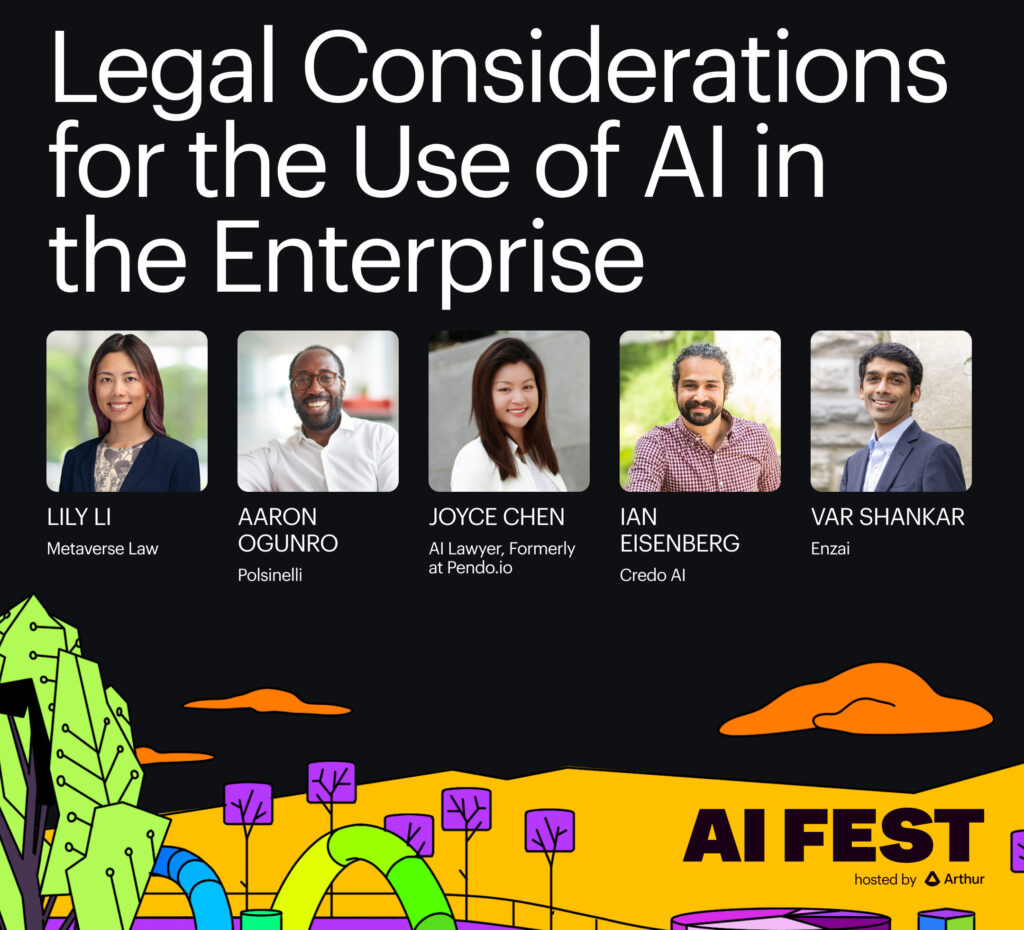
Graphic for Arthur AI Fest.

Metaverse Law at AI Fest

Metaverse Law’s Lily Li recently spoke at Arthur’s inaugural AI Fest. Lily was on a panel that spoke about legal considerations for enterprise use of AI.

The panel explored the complex legal landscape surrounding AI adoption in business. The expert panelists discussed regulatory compliance, data privacy, intellectual property, and ethical concerns, providing actionable insights for companies integrating AI into their operations. Attendees gained a deeper understanding of the potential legal risks and how to navigate them effectively to ensure responsible and compliant AI use in the enterprise.

Click here to view a recording of the session.

Flyer for Arthur AI Fest discussion titled "Legal Considerations for the Use of AI in the Enterprise."

If you would like to discuss your company’s use of AI, please email us at Info@MetaverseLaw.com to schedule a consultation.

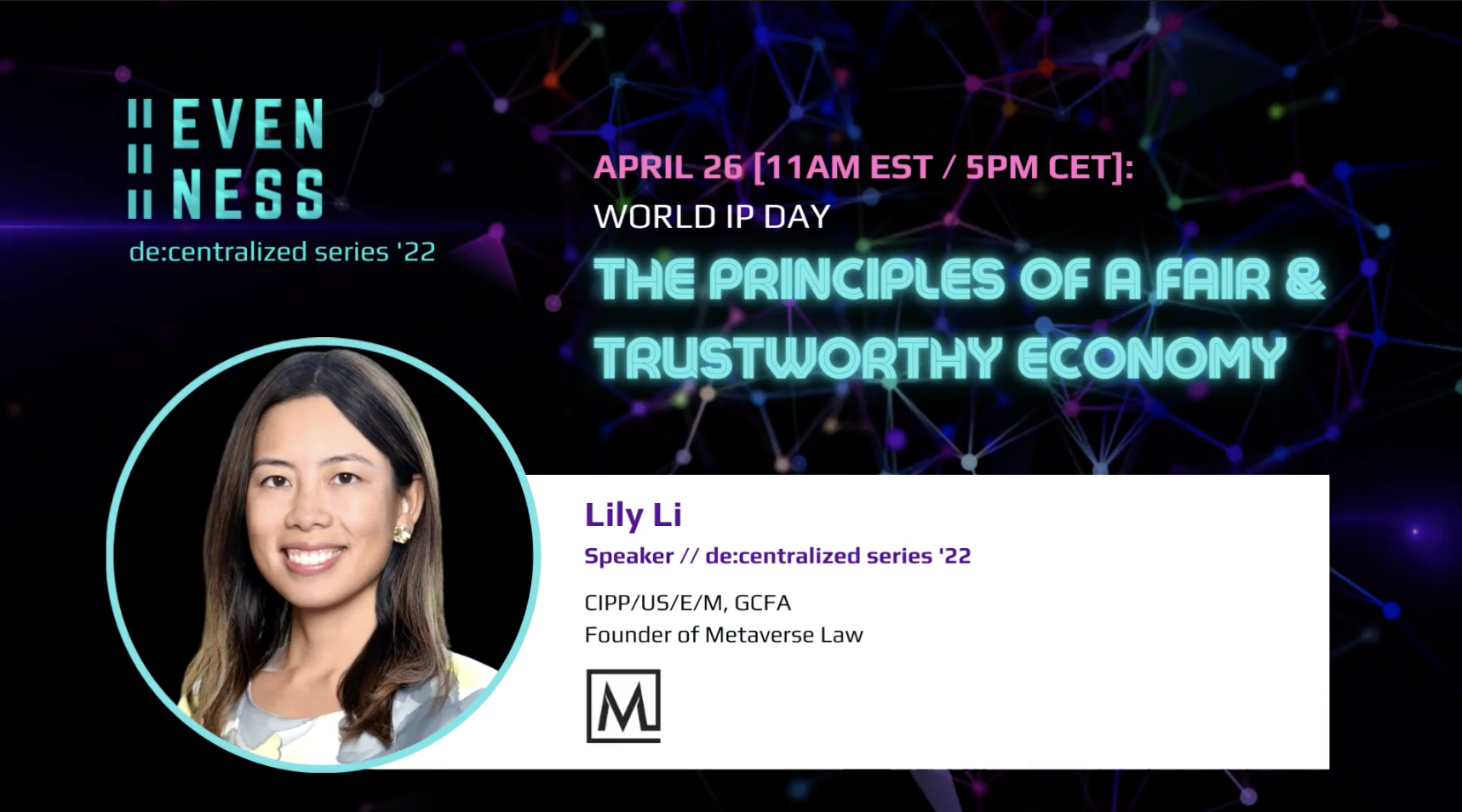
Image of Lily Li, Founder of Metaverse Law and time and date for Evenness' de:centralized series '22 event "The Principles of a Fair & Trustworthy Economy."

Metaverse Law to Speak at World IP Day event

On April 26th, World IP Day, Lily Li of Metaverse Law will be a panel speaker for the “Principles of a Fair and Trustworthy Economy” event. This event is organized by Evenness in partnership with Women in AI and is part of a series of events about frontier technologies, the metaverse, NFTs, virtual fashion and more.

Join us on April 26th at 11am EST/ 8am PST/ 5pm CET for this event. The virtual doors open 30 minutes before the event. Click here for more information.

1 2